Monday, April 15, 2013

Artwork (Again!)

Let's rant and rave a little bit on artwork again, kiddies.  A subject that, frankly, intrigues me.  A link in the publishing chain that has, traditionally, not been a focus for authors.  Either because the author wasn't/isn't interested in what kind of cover will grace their literary effort . . . or more likely not involved because traditional publishers have  consistently viewed that decision as being in their bailiwick and not in the author's bailiwick.

But as you may have noticed . . . the publishing world is changing.  And so too should a writer.

If you're a writer you should be intimately involved in the selection process.  If you're lucky enough to pick up a traditional publishing contract, what a potential reader sees on a book shelf could be the critical deciding factor in the decision to buy, or pass up, that purchase.

I think the same thing is true for ebooks.  Nope, most potential readers do not browse when they shop for a book to read on the internet.   But, along comes an eye-popping cover in a genre they're interested in, and I'd betcha half interest in the Brooklyn Bridge said curious reader will stop and closely examine both the artwork and the contents the artwork represents within.

Therefore let me reiterate.  As a writer you should be closely involved in the design and look of the book cover.  You should find an artist(s) whose style appeals to you.  Hopefully an amicable working relationship evolves between you two where give-and-take suggestions back and forth between artist and writer helps create the perfect image.  Use the world 'collaboration.'  It fits perfectly in what I'm trying to say.

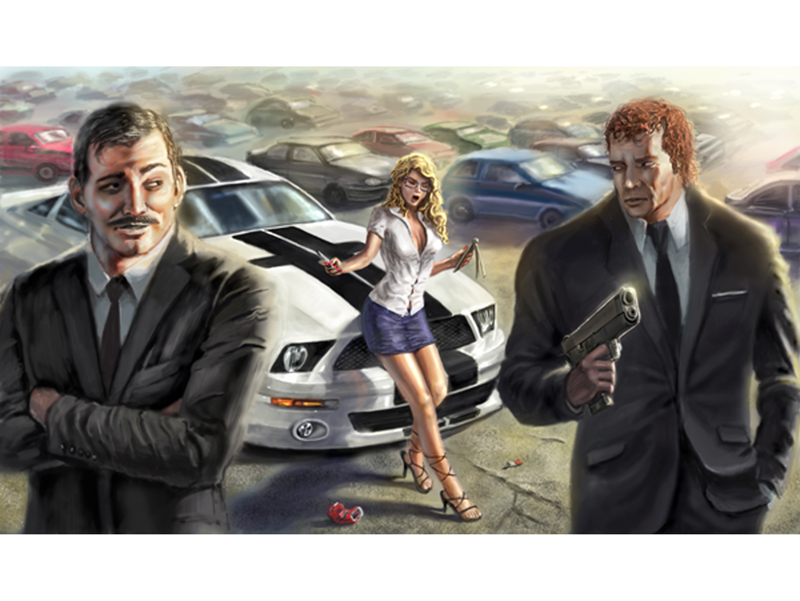
Above is the finished process for the cover of a book of short stories called The Turner Hahn Files: Twenty for the Grave.  It's not out yet--still looking around for a publisher (and one may be very, very, very close to saying 'yes').  Twenty short stories featuring Turner Hahn and Frank Morales.  Stories that stretch over a two and a half year span of time.

The artist(s) are a couple of brothers Javier and Jesus Carmona of Madrid, Spain.  We've worked on other projects of mine before. Mostly my Fantasy novels (see Roland of the High Crags cover in the list of books in the right hand column).   I like their use of vivid color; their composition and lay outs, their attention to detail.  But more than anything, I truly enjoy their desire to work closely with me in coming up with the perfect image.

The above illustration started out as a mental image in my minds' eye.  Especially the background: the polished green marble with the gold veins.  My original idea was to have the two standing together like you see now . . . but in submitting my idea to the two in writing  I didn't make it clear enough.  So the rough-draft version came out looking like this.

I'm sure you see the differences.  More importantly I'm sure you see in the rough draft no visual representation of what the marbled back ground would look like.  A very important point.  When you select an artist to help you out, you have to rely their artistic ability to get the whole design hammered out correctly.

So there was an exchange of emails.  I suggested changing the hands on Turner.  We discussed the marble background.  There was another discussion on making the two look like they were 'moving' somehow.

In the end: Voila!

The perfect image!

I plan to use this image on more collections of Turner/Frank short stories in the future.  When they come out the artwok will essentially be the same---but with some differences.  Very slight alterations in the color of their suits and ties.  Maybe a more wind-blown look involving Turner's hair.  (Oooooh!  I like the idea, for instances, of 'punching' gouged out bullet holes in the marble behind them.  That'd look really neat.)

The writer and the artist in close collaboration in the making of a book cover.  Absolutely essential in my estimation.

(By the way, looking for an artist to hire?  Allow me to recommend the Carmona Brothers of Spain.  You'll find they could very well be interested in hearing from you. Look at the selection of sites to wander through and find Carmonaart.  Contact them there.)

Wednesday, April 10, 2013

Writing Mentors

A writing mentor.  Every writer needs one.  You want to be a writer you first start out being an avid reader.  Or . . . . you should.
You read hundreds of books.  Thousands of books.  Finish one, immediately pick up the next.  There is no stopping.

But somewhere down the line the bug bites you.  Or like a Grizzly in heat, mauls you.  That urge to write.  You get this itch under your collar; your mind gets restless.  All kinds of strange plots for stories explode into your conscience and you've just GOT to sit down and hammer it out on paper or a computer screen!

That's when you know the Writing Bug has taken a chunk out of you behind.  It's permanent now.  There is no antidote. No divorcing it.  The two of you are going to grow old together.

But the thing is this; you need a mentor . . . a favorite writer . . . to show you the first initial steps in writing whatever it is that's rolling around in our nogg'en.  I sincerely doubt any writer started out absolutely fresh.  Coming up with his own personal 'voice' (as MFA professors will tell you you need to find in writing classes) without first mimicking your favorite writer.

As your probably by now have guessed, I write (love) the mystery/detective genre.  I'm not saying I'm good at it.  Or successful at it (yet).  But I am saying I love the genre and occasionally . . . occasionally . . . have written a story or two I'm particularly proud to claim as my own.

And it wouldn't have been possible without the mentoring from a writer by the name of Ed McBain.

Ed McBain, or by his other pen name (one of many) Even Hunter. . . or by his real name, Salvatore Albert Lombino . . . was a New York writer who was prolific in his writing.  Using the McBain moniker he wrote detective/mystery novels.  And his most accomplished success was the fabled 87th Precinct series.  The 87th introduced me into the sub-genre of the detective novel called police-procedural.  Writing about cops and their line of work.  McBain was a master at this, introducing us to a number of hard working, mostly honest, sometimes foolish, homicide detectives out of the 87th.  Each on you got to know personally.  They were three-dimensional.  Well rounded.  They actually breathed.

But what truly made me admire this man . . . and thus want to mimic him . . . was the crisp brevity of his writing.  Clean, sharp, crystal clear.  Short, precise sentences which grabbed you and bodily hurtled you into the middle of the scene with vivid intensity.

If you can write like that, bambino, you're a writer.  A damn good writer.

McBain . . . just for the 87th Precinct series . . . churned out something like 55 novels.  God knows how many he wrote if you add in all his pen names and his real name.  He averaged about two novel a year for decades so that should give you an indication he was prolific.  But as Ed McBain the 87th was/is his crowning legacy.

And in my opinion, nobody writes a police-procedural better.  But of the 55 books in the series, the six novels which introduces a deliciously evil genius know as The Deaf Man stands head and shoulders above everything.  Talk about being diabolically evil!  Wow!  A complex creature who . . . in the end . . . walks away and is never caught.  He's still out there somewhere plotting his next caper.

The best book in the series (always subject to change, mind you) is one called Eight Black Horses.  The Deaf Man plots a very intricate game of wits to challenge and irritate the detectives of the 87th as he prepares for a spectacular robbery.  Brother, the writing in this one so spectacularly brilliant!  Five pages into this one and you know, just know, you are reading the words uttered from a master story teller.

So there you are.  You're a writer.  You want to be the best writer you can possibly be.  Well, be one!  Find the writer who moves you the most.  Experiment with his style.  His voice.  Branch out--try some sentence structures of your own design.  Throw in, or discard severely, descriptive phrases until you find something that fits your standards. (that's finding your own Voice, by the way . . . just in case you didn't pick up on that)

Voila!  Master your own style and you've become a real writer!

Which means, of course, that like the rest of us you'll starve to death trying to earn a living off your writing and your name will be forgotten completely the day after they throw your coffin in the ground.

But, hey!  That's Life, ain't it?

Tuesday, April 2, 2013

The proverbial side-kick

Let's talk about gumshoe side-kicks.  You know, the Doctor Watson wannabes.

I've never really liked'em.   I'm thinking of creatures especially like Hercule Poirot's Captain Haskins in the early Agatha Christie novels.  Or  the bungling, but lovable old buffoon of a Dr. Watson played by Nigel Bruce in the Basil Rathbone Sherlock Holmes movies of the 1930's.

Clownish amateurs there to screw up the crime scene, maybe give a little humor to a story, but really present to build up the brilliant detective work and intellectual genius of the main character.

Two emotions come to mind at the same time.  One is Yuck! And the other is Why?

The Yuck comes to mind because, in my opinion, the buffoonish nature of a Captain Haskins is just too distracting to the overall story.  It is a physical and obvious insertion of a sounding-board . . . or automatic applause machine . . . the author slaps in to get the reader to appreciate the main character better.  Unneeded and unappreciated.

The Why? comes in asking this question;  "Why so buffoonish?  And why so amateurish?"  Can't an author create a side-kick who is smart and intelligent?  One who can infuse a little humor (if its needed) into the plot without making him look like he was just released from a loony farm?

I say there is.  And I have a few examples (although two of them are not the 'humorous' kind of fellas to be around).

If you've ever read Robert Crais' Elvis Cole series you run across a character by the name of Joe Pike.  Ooooooh . . . . one mean SOB!  Someone you wouldn't want to be on their bad side.  But one hell of an ally when the chips are down.  Joe Pike is no second hand caricature to be easily dismissed.  He's every bit as talented and every bit as tough (maybe even tougher?) than Elvis Cole.

A second side kick that comes to mind is Hawk from Robert B. Parker's Spenser series.  Big.  Mean.  Bald.  And very loyal.  So good in fact one quietly speculates on what would have happened if Hawk and Spenser became enemies.  Who would come out the winner on that one?  It'd be a toss up, fella.  A real toss up.

The absolute best example of a side kick I'd root for is the Robert Downing Jr. Sherlock Holmes movies featuring Jude Law as Dr. Watson.   Two movies in this re-imaging of of this classic character where  Dr. Watson is portrayed as being a near-intellectual equal to Holmes.  But more importantly, Watson is absolutely essential to Holmes' success.  Therefore he is an equal to his more famous compatriot. 

Jude Law's portrait of Dr. Watson brings wit, sarcasm, humor, humanity and genuine friendship to play in these moves.  Absolutely astonishing to watch!  I could watch (and fervently hope the do!) this cinematic series forever.

I'm writing this as a blog today because of the red headed guy in the artwork at the top of the blog.  The red head is Frank Morales.
The side kick to Clark Gable lookalike, Turner Hahn.  Both of'em are homicide detectives and partners.  And so far, in the 23 or so short stories and 3 novels I've written featuring them, both are in almost every scene together playing off each other.

But maybe it's time for Frank to spread his curmudgeon's wings and fly on his own power.  He's certainly is capable of taking on cases by himself.  Technically he's smarter than Turner when it comes to sheer IQ numbers.  And his personality is . . . shall we say . . . a little more brutally direct than Turner's.

Together Turner and Frank make a great investigating pair.  But separating Frank from Turner and giving him his own cases to solve creates some interesting possibilities.  Of course the red headed SOB won't like it . . . being on his own.  He's very smart and very observant.  But the one thing he isn't is he doesn't play nice when he's on his own.

But not being able to do the nice-nice makes for great possibilities.  Don't you think?

Thursday, March 28, 2013

Gloves Off is Out!

Here it is.  Darren Sant and Craig Douglas' Gloves Off.  A heaping together of nineteen of the roughest, toughest, most critter-like writers of hardboiled, noir, and horror to be assembled under one pup tent.

And yes, I've claimed my little spot of space underneath the tiny patch of canvas along with the others.  I've got a story in here entitled 'Cold.'
 
I've got to say that I'm very pleased to be associated with this assortment of bad asses.  There is some truly genuine talent in this gathering.  Talent like Richard Godwin, Graham Smith, Paul D. Brazil and Gareth Spark.  To be asked to contribute something of mine was a great honor.  To be even remotely ranked up there with the headliners featured in the anthology is kinda intoxicating.

Who knows?  I might turn out to be a genuine writer after all.

The bloke who came up with this nifty idea, Darren Sant, has an ezine called Near To The Knuckle.  Over the last two years I've hacked together some stories and bopped them electronically over to England for him to consider.  Surprisingly he's accepted every one I've sent. (either a terrible case of amensia overwhelms him every time one of my stories comes up for review and he thinks I'm someone else  . . . or maybe he just likes what I write.  The first option makes sense.  The second option would be nice too.)

Near To The Knuckle covers a wide spectrum of stories which, in one way or another, involves a bloody mess and a dead body stuffed in some one's closet somewhere.  Or maybe underneath a divan.  Or a street gutter.  Or . . . well, you get the picture.  Lots of writers show up with their unique prose and styles.  From all over the world.

That's one of the two things I've grown to enjoy with the coming of the Internet.  The first is this tremendously huge rebirth of writing short stories which seems to be directly attributable to the invention of the electronic age.  And secondly ezines popping up everywhere willing to pull in writers from all over the world to fill their pages with stories. 

It truly is a writing renaissance we're witnessing.

Go get you a copy of this anthology.  You won't regret it.  And then come back  and tell me what you thought of my story.

(Of course it is the best in the lot!  I wouldn't be a real writer if I didn't secretly believe that!)

Friday, March 22, 2013

Promises unkept and other things

If you're a writer, how long have you been writing?  It struck me earlier today that I've been writing over a significant span of my life time.  So I took the time to think back and remember the very first story.
The year was 1960.  Fifty-three years ago.  Wrote in long hand in a spiral notebook a complete  novel.  Hard core science-fiction.  Back then I was twelve years old and had just discovered the amazing worlds of Edgar Rice Burroughs.  In one summer I read'em all.  All the Tarzan novels.  All the Barsoom (Martian) novels.  All the Vesuvian novels.  All of 'em.

After Burroughs came the others.  Isaac Asimov.  Robert Heinlien.  Arthur C. Clarke.  Poul Anderson.  H.G. Wells. Dozens more. Any and all science-fiction writer I could get my hands on.  And the more I read the more I thought about the idea of trying my own hand at writing something.

Along the way I ran into, and fell in love with, hardboiled detective stories.  Sumbitch!  More stories to write!  I quickly realized I'd be writing something or another for the rest of my life.

Of course the story written  long hand is gone.  Long forgotten and misplaced.  But I've been writing continuously ever since.

What also occurred to me about this long ole' journey through my imagination is this;  the promises unkempt.  Fifty three years of trying to get published you contact and talk to a lot of different people.  Other writers, god knows how many editors, a shit-pot load of agents.  Most of them were honest enough to tell me they were not interested.  In fact the vast majority of publishers and editors were quite blunt about it.  Yeah, at first, blunt rejections like this kinda hurts the old ego, pilgrim.  But if you're a writer you've got to expect it.  Expect it and push past it.  I endured and developed that thick skin of invisible armor all of us have to acquire in one fashion or another.

But the publishers and agents who were the nasty little chameleons in life. . . the ones who just loved my work and promised me the world . . . only to dump me the moment the rowing became tough for them; those are the chinks in my armor.  The promises unkempt.  Those are the ones that still ring my chimes and pisses me off.

Oh, well.  Who the hell said that Life was going to give you a fair handshake, pat you on the back, and send your jolly self off into the sunset with a grin on your face and success in your pocket?  If someone has said that, I must'uf missed the memo.

(Okay, Hermione.  I'm finished bitch'n now and going back to write something.)

Monday, March 4, 2013

My Five Best Westerns

A few days back someone printed a list of his five best Westerns.  It got me to thinking.

As a film genre goes, the Western has fallen on bad times.  Hardly see one being made these days.  Which is a  resoundingly foolish mistake Hollywood is committing if you ask me.  The Western can't get any more American as a film type.  It literately encapsulates what Americans have always thought of themselves.  Rugged, independent, honest, tough as rawhide, and reliable.  Interestingly that image (whether it's right or wrong is immaterial) hasn't changed in 200 years.  It's what we think we are. 

Every nationality has an image of themselves.  And every nation's movie producers try to fill that image with visual representations for its audience.

So I'm thinking the Western should be making a BIG come back soon.

Anyway . . . .  we were talking about the five best Westerns ever made.  Let's continue down that murky road and see where we come to a screeching halt, shall we?

First of all, how do you make such a selection.  What is the criteria you're using to make the selection?   What's the time frame, for instance.  The years between 1800 and 1900?  Between 1700 to 1900?  That is an issue.  What defines the period when a Western is a true Western?

Can a Western be a comedy?  Think of Mel Brook's Blazing Saddles.  Is that a real Western?  Or more like a Comedy dressed up in western clothing?  Is a Western solely a drama?  Could it be a Musical like Paint Your Wagon or Oklahoma?  How about all those Gene Autry movies where they  mixed horses and automobiles together in the movies made in the middle and late '30's?  Hmmm . . .

Okay.  Cut to the chase;  my definition of a Western.  Drama; depicting the American West between 1800 to 1900.  Here goes;

1.  The Searchers (filmed, 1956)

2.  The Man Who Shot Liberty Valence (1962)

3.  Magnificent Seven (1960)

4.  Unforgiven  (1992)

5. (tie)  Stagecoach (1939) and My Darling Clementine (1946)


If you're a movie buff you've already seen this list about six or seven times apiece.  And quite willing to sit down and see them all over again.  They're classics.  Great movie plots with genuine stories that pull you in immediately.  Great scenery to behold the American West.  Great photography . . . both in color and in black and white . . . that just fires up your imagination.  And of course . . . great acting.

John Wayne is in three of the above movies (The Searchers, The Man Who Shot Liberty Valence and Stagecoach).  Let's face it.  When it came to depicting the rugged, silent type, no one beats John Wayne.  He's the flawed loner  . . . the honest man who, despite his flaws, knows the right thing and does it.

But I'm giving a big 'Hi Ho, Amigo!' to Yul Brynner (Magnificent Seven).  There's just something about this ball headed gunslinger that grabs you.  One tough SOB.

And then there's Henry Fonda.  There's a basic streak of Just Plain Honesty in the man you've got to admire in this movie.  Honesty and Commitment.  Love this oldie.  Love'em all.

Oh, by the way . . .

The photo above.  Coming out of the last scene of The Searchers.  Wayne brings his niece home after years of captivity with a band of Comanches.  He once swore that he was going to kill for fear she had 'gone indian.'  But in the end he saves her life and brings her home . . . and stands in the doorway after the family gathers around her and then turns, and walks into the sunset.

Classic American chutzpah.

Tuesday, February 26, 2013

How do you write?

How do you write a scene?  A chapter?  A novel?  Specifically, how important is imagination when you're writing?  How important is the art of description when you write?

I broach this subject because a friend of mine (Paul D. Brazil) posted on Facebook a recommendation for a Turner Hahn/Frank Morales book currently out called A Taste of Old Revenge (find it down in the column on the right).  He said that the book is full of visual images that, if properly captured, would make for an exciting movie.

Wow.

In one brief sweep of keystrokes Paul perfectly described the way I write.  Using words to paint an image.  Literately.

I don't know about you but I'm not a happy troglodyte when it comes to today's genre fiction.  It's too . . . fracken . . . bland.  There's no color.  No visceral involvement pulling the reader into the action.  In essence, today's writing makes for sensory deprivation for the reader.  The reader is standing off in the distance with a huge telescope watching the action from a safe distance.  Removed from the bleeding, the sweat stinging one's eyes, the feel of cold steel in a gun man's hand, the smell of fresh blood oozing out of a bullet hole.

I don't want to write like that.  I don't want a reader to be an observer.  I want the reader down in the dirt.  I want him rolling in the muck and feeling the pain.  I want him to taste . . . literately taste . . . fear.  I want him to know how it feels to really lose someone you love.  Or the narcotic burst of raw emotion when you defeat a foe superior to you in every measure possible.

Writing like this requires the application of imagination and descriptive qualities measured in just the right proportions.  Too little and you're just writing like the other cookie-cutter clones that have flooded the market.  Too much imagination and description and you turn off the reader's imagination.

Not good, Tonto; not good at all.  The reader's imagination is very important.

On the other hand . . .

I wonder . . . often . . . if perhaps the reader's imagination is overrated.  I wonder if we overestimate the reader himself.  Publishers and literary agents will tell you that too much description will kill a good read and turn off the reader.  Essentially I agree with that.  But on the other hand, a reader picks up a book to be entertained.  He doesn't necessarily want to fill in the gaps mentally.  He wants to see the action unfolding before him.  He wants to hear the bombs exploding.  A story aptly described puts the reader right in the middle of the fight.  Little imagination is required.

You don't go to a James Bond movie and just see the figure of James Bond, alone, fighting an imaginary villain with the expectation that the movie goer must mentally fill in the empty screen with the necessary details to complete the picture.  Each scene of a movie is painstakingly designed visually to create an effect.

What I am saying is a book should be composed the same way.

Each chapter of a novel I write is set up visually first; plot second.  Quite possibly my writing could be described as me stringing a series of visual vignettes together that, taken as a whole, makes the novel complete.

To be honest one of the two reasons I became a writer is because I am not that happy troglodyte I mentioned earlier.  I'm not happy with today's writing.  So I decided to write stories I want to read.  (the other reason I became a writer is simple;  I like to tell stories)

But here's the rub.  Am I a successful writer?  Are my works as plentiful and well received as hundreds of writers are today.

No.  By any standard of measurement I'm just another small fish in a very big body of briny water.
But this is the way I roll, baby.  And I'm thinking the market is so large, so diverse, so complex, that my way of writing would find a sufficiently large enough audience to enjoy some measure of success.

Or not . . . Who the hell knows for certain.